
Welcome to Nepal. Upon arrival at Tribhuvan International Airport, you will be met by our expedition team and transferred to your hotel in Kathmandu. After check-in and rest, there will be a briefing covering the expedition schedule, climbing permits, equipment, safety procedures, and upcoming logistics.
Image
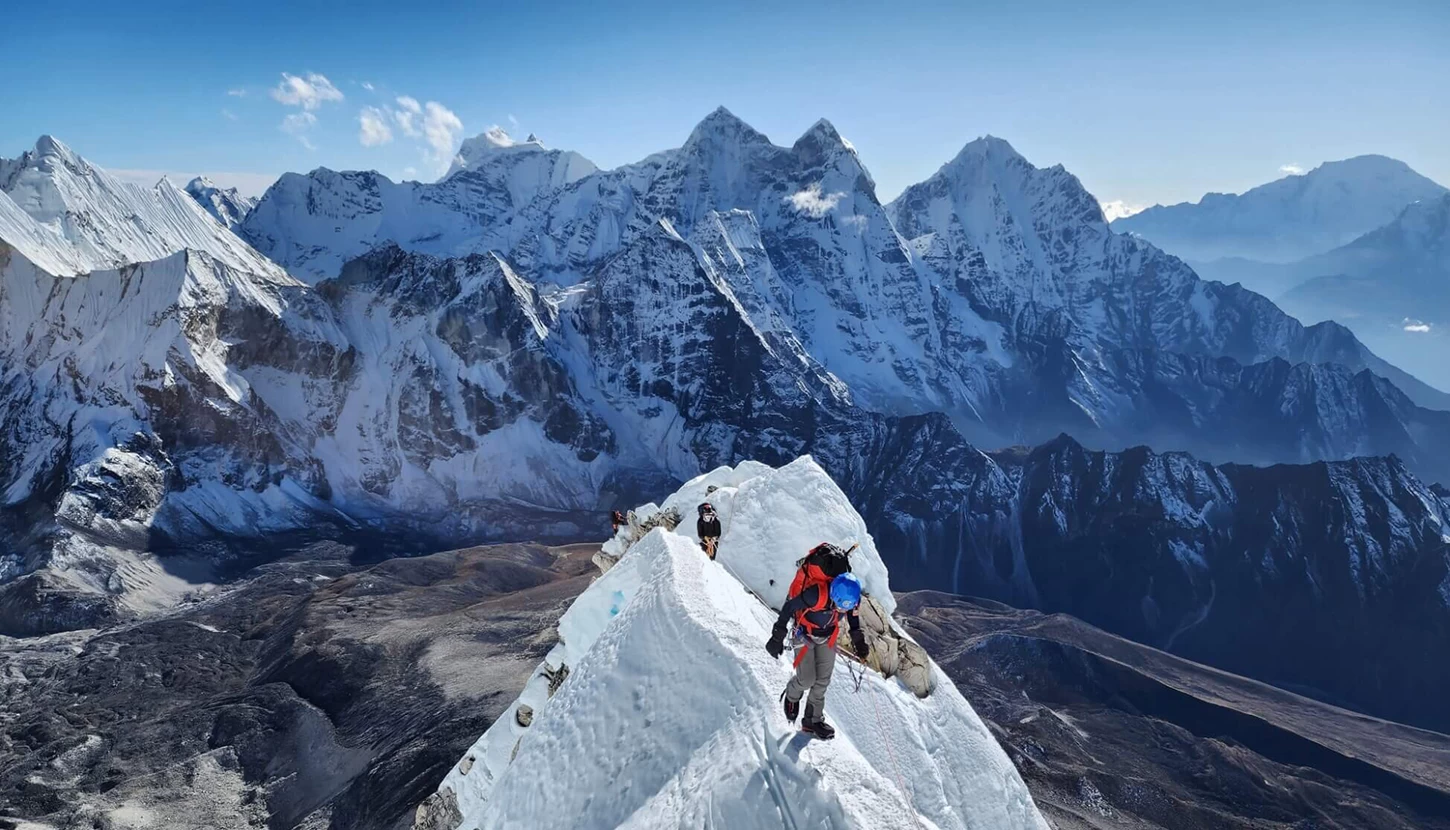
Ama Dablam (6,812 m), the iconic jewel of the Himalayas and one of the world's most beautiful alpine climbing peaks.
01 / 07
Summit the Jewel of the Everest Region
Ama Dablam Expedition (6812m)
Ama Dablam Expedition is one of the world's most iconic alpine climbing adventures. Standing at 6,812 m in Nepal's Everest region, this technical climb follows the spectacular Southwest Ridge through rock, snow, and ice. Trek via traditional Sherpa villages, enjoy breathtaking Himalayan scenery, and experience the challenge and reward of summiting one of the most beautiful mountains on Earth.
ActivitiesClimbing
Group SizeMin. 2 Pax
Trip Highlights
Summit the legendary Ama Dablam (6,812 m), the most beautiful mountain in the Himalayas.
Experience a world-class technical climb over rock, snow, and ice on the famous Southwest Ridge.
Trek through traditional Sherpa villages, ancient monasteries, and the spectacular Everest region.
Enjoy breathtaking views of Everest, Lhotse, Makalu, Nuptse, Baruntse, Thamserku, and countless Himalayan giants.
Route Plan
Itinerary
Today is dedicated to final expedition preparation. We will check climbing equipment, clothing, technical gear, personal supplies, and other essential items. The expedition leader will provide a detailed briefing about the Ama Dablam climbing route, acclimatization strategy, weather, safety, and communication procedures.
In the evening, enjoy a traditional Nepalese welcome dinner with the expedition team.
An early morning flight takes us from Kathmandu to Lukla, the gateway to the Everest region. After landing at Lukla, we begin our trek through the beautiful Dudh Koshi Valley. The trail passes through small Sherpa settlements, forested hills, and suspension bridges before reaching Phakding.
After breakfast, we follow the Dudh Koshi River toward the famous Sherpa town of Namche Bazaar. The trail crosses several suspension bridges and enters Sagarmatha National Park. The final section climbs steadily through pine and rhododendron forests toward Namche.
On a clear day, you may get your first impressive views of Everest, Lhotse, Nuptse, and Thamserku.
A crucial acclimatization day helps your body adjust to the increasing altitude. Rather than remaining completely inactive, we take a gradual acclimatization hike around Namche and the surrounding viewpoints.
Depending on conditions, the hike may include the Everest View Hotel area, Khumjung, or nearby ridges. The afternoon is reserved for rest, hydration, and expedition preparation.
We leave Namche and follow the trail toward the Gokyo Valley. The route climbs gradually through rhododendron and juniper forests, passing Mong La and continuing along the Dudh Koshi Valley.
The landscape becomes increasingly alpine as we gain altitude and approach Dole.
Today's trail continues through the upper Gokyo Valley. The vegetation becomes sparse as we climb higher, with spectacular views of Cho Oyu and surrounding Himalayan peaks.
We follow the Dudh Koshi toward Machhermo, a small settlement surrounded by dramatic mountain scenery.
Today we enter the spectacular Gokyo Valley. The trail follows the Ngozumba Glacier and climbs toward the turquoise waters of the Gokyo Lakes.
After reaching Gokyo, we have time to explore the lakeshore and enjoy views of Cho Oyu, Gokyo Ri, and the surrounding Himalayan peaks.
We make an early morning ascent of Gokyo Ri, one of the finest viewpoints in the Everest region. From the summit, panoramic views extend toward Everest, Lhotse, Makalu, Cho Oyu, and the Ngozumba Glacier.
After descending to Gokyo, we continue toward Thangnak, following the dramatic glacier landscape.
This is one of the most challenging trekking days before reaching Ama Dablam Base Camp. We climb toward the spectacular Cho La Pass at approximately 5,420–5,430 m, depending on the route and conditions.
After crossing the pass, we descend carefully toward Dzongla, surrounded by some of the region's most impressive mountain scenery.
We descend from Dzongla toward the Imja Valley. The trail passes through Lobuche and continues toward the lower Khumbu villages.
As we descend, the air becomes noticeably richer in oxygen. We eventually reach Pangboche, one of the oldest Sherpa settlements in the Everest region.
Today is an exciting milestone as we approach the magnificent Ama Dablam. The trail climbs through the Imja Valley toward Ama Dablam Base Camp.
The imposing south face of Ama Dablam dominates the landscape as we approach the expedition base camp, where the climbing team will establish itself for the summit phase.
Today is an important preparation and acclimatization day at Base Camp. The climbing team will conduct technical training and review essential mountaineering techniques.
Depending on the expedition plan and conditions, training may include fixed-rope techniques, ascending and descending fixed lines, crampon movement, climbing-system checks, communication procedures, and emergency protocols.
Our climbing Sherpas and expedition leader will also inspect personal and group equipment before the higher camps.
Today we make an acclimatization excursion toward Ama Dablam Advanced Base Camp. The route gradually enters steeper and more technical terrain, providing an opportunity to become familiar with the lower section of the climbing route.
After spending time at higher elevation, we descend according to the acclimatization plan and return to Base Camp.
The climbing phase begins. We leave Base Camp and ascend toward Camp I. The route becomes increasingly technical, requiring careful movement over rocky and exposed terrain.
Camp I, situated at approximately 5,700 m, provides the first major high-altitude camp on Ama Dablam.
Today we continue higher toward Camp II. The terrain becomes more technical, and fixed ropes are used on sections of the route.
The famous Yellow Tower section is one of the key technical features of the climb. After reaching Camp II, the team rests and prepares for the summit push.
The summit day begins very early. Under suitable weather and route conditions, we climb toward the summit of Ama Dablam.
The upper mountain requires sustained technical climbing and careful use of fixed ropes. Reaching the 6,812 m summit offers extraordinary views across the Everest region and is the culmination of the expedition.
After celebrating the achievement, we begin our descent, aiming to reach a lower camp according to weather, route, and team conditions.
After the summit push, we descend from the higher camps toward Ama Dablam Base Camp.
This is primarily a recovery and descent day. The expedition team packs and organizes climbing equipment while enjoying a well-earned rest at Base Camp.
We leave Base Camp and descend through the beautiful Imja Valley toward Tengboche.
Tengboche is famous for its historic Buddhist monastery and spectacular panoramic views of Ama Dablam, Everest, Nuptse, Lhotse, and Thamserku.
The trail descends through rhododendron and pine forests before crossing the Dudh Koshi and climbing toward Namche Bazaar.
After the demanding expedition, this section provides a more relaxed trekking experience as we gradually return toward the lower Khumbu.
Our final trekking day follows the Dudh Koshi Valley back toward Lukla. We pass through familiar Sherpa villages and suspension bridges before reaching Lukla.
In the evening, we celebrate the successful completion of the Ama Dablam Expedition with the expedition team.
Weather permitting, we take an early morning flight from Lukla back to Kathmandu.
Upon arrival, transfer to the hotel and enjoy a well-earned rest. The remaining day is free for relaxation, shopping, or exploring Kathmandu.
Your Ama Dablam Expedition officially comes to an end today. Depending on your international flight schedule, our team will transfer you to Tribhuvan International Airport for your onward journey.
We say goodbye with unforgettable memories of the Himalayas and the achievement of standing on Ama Dablam's 6,812 m summit.
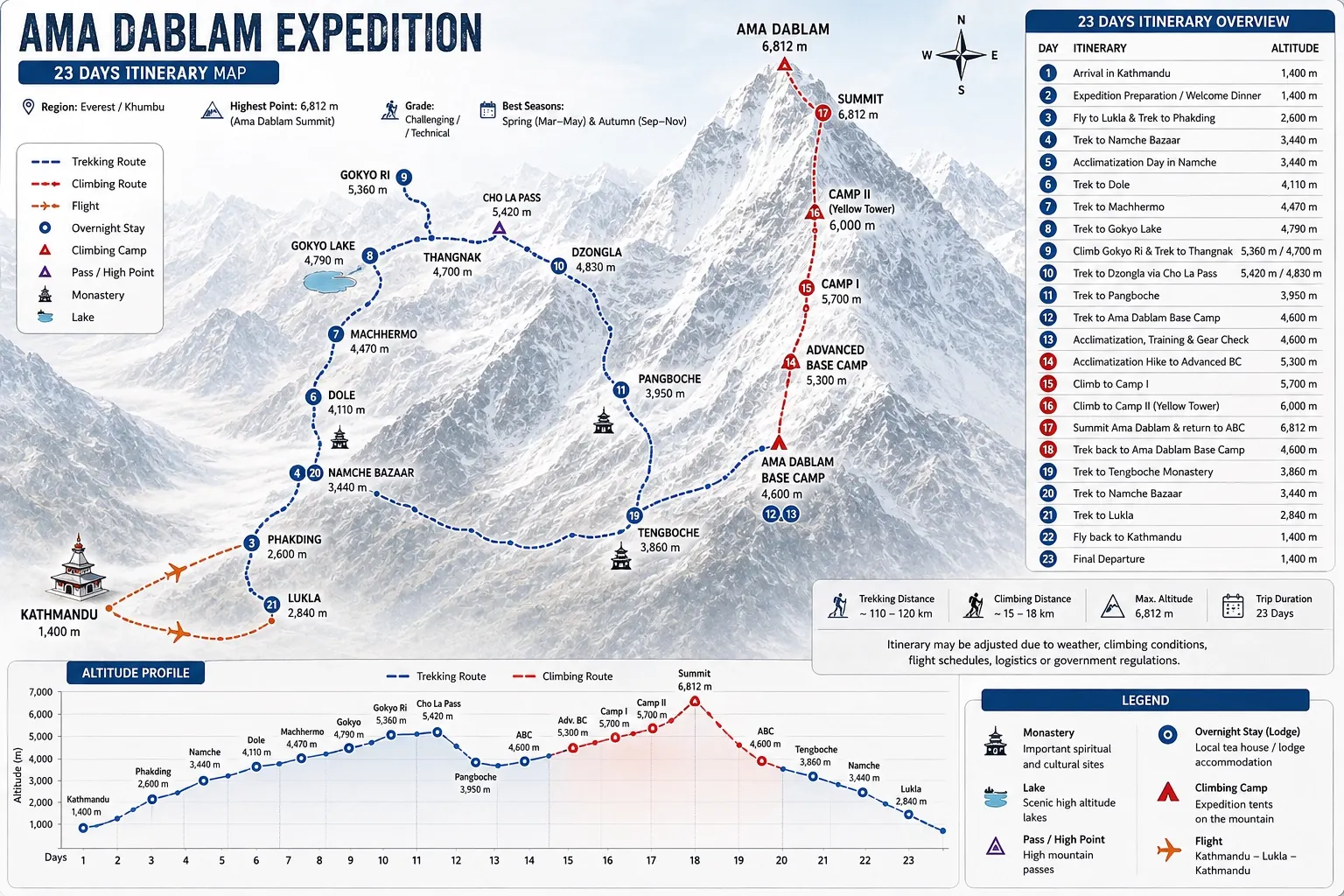
Journey map
Explore the complete route
Review the full journey, daily stops, elevations, and route direction in one view.
Trip essentials
What's included?
Review exactly what is covered by the trip price and what you should arrange or budget for separately.
All arrival and departure transfers in Kathmandu.
3 nights of hotel accommodations in Kathmandu on BB Plan.
return flights for Everest
two-way transportation from Kathmandu.
Mt. Ama Dablam expedition permit
Government official Liaison Officer for Ama Dablam Expedition.
Local government tax & Sagarmatha National Park entry permit & TIMS card.
All camping equipment in Advance Base Camp and other camps.
Food, accommodation and guide during trekking in teahouse/lodge.
Food during the expedition period cooked by our experienced cook.
1/1 experienced private climbing Sherpa guide for climbing support.
Baggage allowance carrying by mules/porters up and down to BC: 40 kg.
Required high-altitude food for climbing members and Sherpa.
Required fixed and dynamic ropes for climbing by Sherpa Guide.
Insurance, wages, meal and allowances for climbing Sherpa and BC staffs.
Solar panels for light and battery charging in base camp.
Ice-fall and rope fixing charges, tents at high camps C1 & C2
First Aid medical kits for the Group and the staff.
Walkie-talkies & satellite phone for communication
Office service charges and government taxes levied in Nepal.
Welcome & Farewell Dinner
Trip lookbook
A closer look at the journey
Explore the landscapes, camps, trails and defining moments that shape this expedition.
Flexible travel date
Choose your preferred date
Select any future date to check availability.
Selected dateNo date selectedPick a date from the calendar.
CalendarOctober 2026
Selected date
Preparation
What to Bring
Pack confidently with a clear distinction between the equipment you should carry and the items supplied for Ama Dablam Expedition (6812m).
Personal equipment
You should bring
Personal clothing and equipment to prepare before departure.
- Hiking boots with good grip
- Rain gear for you and your day bag
- Comfortable hiking pants
- Quick-dry, breathable T-shirts
- Windproof jacket
- Sleepwear
Operator supplied
We provide
Core trip equipment supplied or arranged by the operator.
- Company duffel bag for porters
- Comprehensive group first-aid kit
- Pulse oximeter
- Emergency communication equipment
There is more to review before departure.Clothing, documents, personal equipment, supplied gear, and optional recommendations.
Expedition enquiry · EVAMA23
Ready to plan your journey?
Send a quick enquiry without leaving this page. Our team will confirm availability, pricing and logistics before you commit.
No payment required Usually replies within 24 hours